

While the PKK retreats into strategic silence, Syria’s former insurgent leader walks into presidential legitimacy—two gestures, worlds apart, yet bound by a common grammar of rebranding. This week’s stage featured disappearing acts, political makeovers, and diplomatic theatre, where absence becomes presence, and spectacle stands in for sovereignty.
🇹🇷 Turkey
- Erdogan eyes peacebroker revival: Offered to host Russia–Ukraine talks in Istanbul; aiming for relevance in multipolar diplomacy again.
- Trump–Erdogan bromance rebooted: Mutual visits teased; “excellent relations” rhetoric returned but Trump’s visit to Turkey for ceasefire talks tied to Putin’s participation and won’t take place.
- PKK announces disbandment: In a historic move, PKK declared its organizational end; Turkish officials frame it as state victory, Kurds online debate co-optation vs strategic retreat.
🇸🇾 Syria
- Sanctions lifted: Trump revoked U.S. sanctions; Gulf and Turkish investors circling reconstruction deals.
- Al-Golani’s glow-up: Ex-jihadi Ahmad al–Sharaa rebranded as Syria’s new prez — from sharia to suits, welcomed by U.S. and Gulf allies.
🇵🇸 Gaza
- Death toll climbs: Israeli airstrikes kill 70+ in Jabaliya alone; over 52,000 Palestinian deaths since war began.
- Hostage released: Hamas freed Edan Alexander, last living U.S.-Israeli captive — diplomatic gesture ahead of Trump’s regional visit.
🇶🇦 Qatar
- Billion-dollar bonanza: $1.2 trillion U.S.–Qatar deals inked, incl. $96B Boeing mega-order.
- Air Force One, Qatari edition: Emir offers Trump a luxury 747-8; optics and ethics both raising eyebrows.
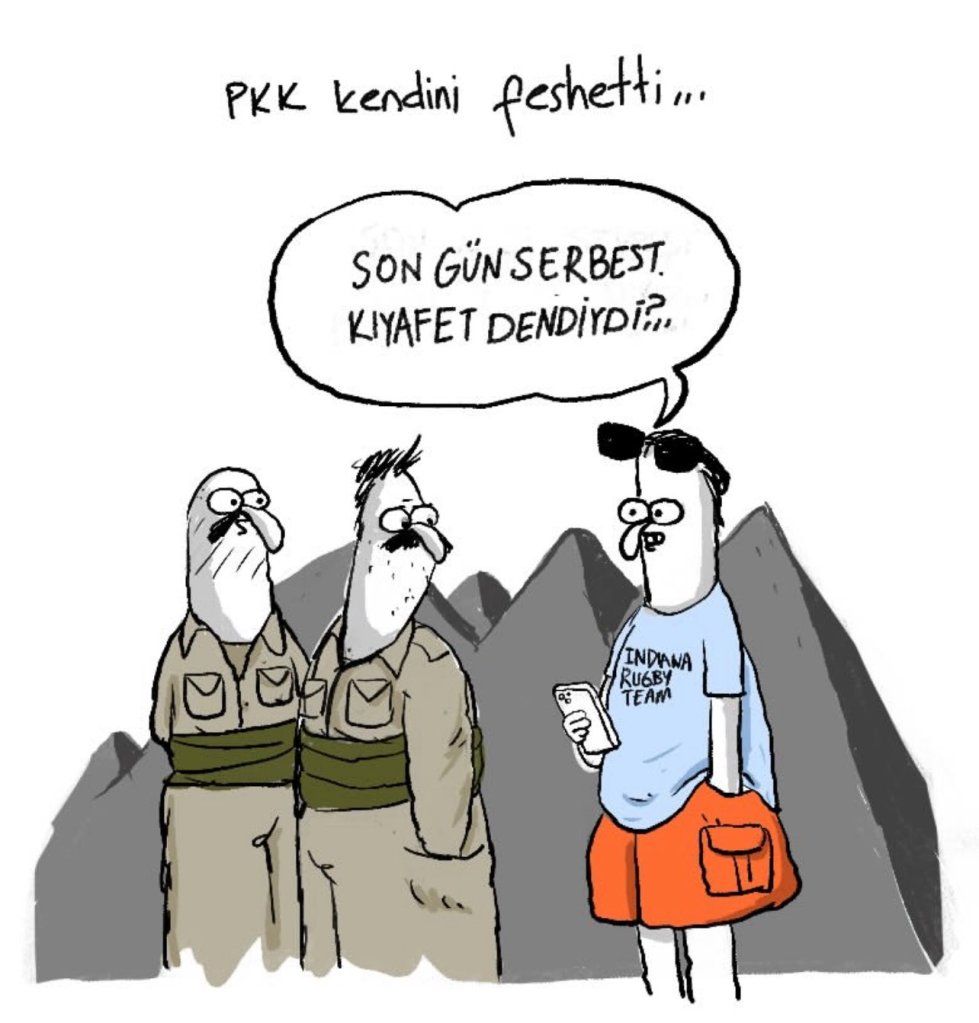
“The PKK Disbands”: Retreat, Rebranding, and the Making of a Void
The reported dissolution of the PKK is not a conclusion—it is a maneuver. In the absence of formal negotiations, reciprocal concessions, or any institutional reintegration framework, the move appears less about peace and more about narrative engineering. Its timing—amid Türkiye’s deepening cross-border operations and normalization overtures with Iraq, Syria, and the Gulf—signals not the end of conflict, but the staging of a vacuum.
This vacuum is not incidental. As Ankara expands its presence in northern Iraq and works to delegitimize the PYD’s role in Syria, the disbandment weakens the PKK’s symbolic centrality in transnational Kurdish politics. It preempts the consolidation of any Kurdish federation-like model beyond Iraq’s Kurdistan Regional Government, particularly in northern Syria, where the PYD’s self-administration has echoed federalist aspirations. In this light, the move aligns with Türkiye’s regional doctrine: not only to neutralize immediate armed threats, but to strategically obstruct the emergence of institutional Kurdish autonomy in its borderlands.
What unfolds is a calculated asymmetry: one actor disappears from the scene—perhaps to shield affiliates, perhaps to reposition—while the state continues to narrate, militarize, and surveil. The PKK is not politically absorbed, nor is it redefined—it is simply removed from the legible political field. As such, this is not inclusion but managed disappearance, a process echoed in Achille Mbembe’s and Judith Butler’s analyses of disavowed life in postcolonial and securitized orders.
This logic draws on what Giorgio Agamben terms the state of exception—a condition in which certain subjects are neither fully outlawed nor granted political status, suspended in a legal grey zone that justifies their continued erasure (State of Exception, 2005). Even in symbolic retreat, the PKK remains fixed within the language of terrorism, its political character unacknowledged. What becomes of the militant in this schema? Not reintegrated, not even defeated—simply reduced to presence that must vanish for sovereignty to reassert itself. This is bare life, Agamben might say: life stripped of political meaning, made tolerable only through absence.
The disbandment, then, is not a concession. It is an act of strategic silence in a theatre where visibility has become a liability. It narrows the political field, delays confrontation, and forecloses the possibility of future federative arrangements. Türkiye doesn’t need to defeat the Kurdish movement—it needs to dissolve its horizon.
So no—this is not peace. It is not even defeat. It is rebranding under pressure, and a calculated silence where new sovereignties were once imagined.
Trump in the Gulf: The Choreography of Deference
Trump’s tour of the Gulf, punctuated by billion-dollar arms deals and palace theatrics, was less a diplomatic engagement than a reaffirmation of hierarchical dependence—a transactional spectacle in which Gulf regimes purchased not just weapons, but continued relevance within a U.S.-anchored security architecture.
These deals do not secure autonomy. They operate as political insurance, reinforcing loyalty through militarization rather than strategy. Arms are acquired not as tools of self-defense, but as tokens of alignment, binding these states to an unequal security economy. This echoes what Timothy Mitchell describes as the geoeconomic entanglement of oil, coercion, and infrastructural dependency in the Middle East (Carbon Democracy, 2011).
Diplomacy here is conducted less through policy than through aesthetic submission. Qatar’s opulent welcome—rumored to involve millions in personal accommodations—functions as a form of symbolic tribute. In this setting, sovereignty is not asserted, but performed through hospitality, and power is mediated through visibility rather than negotiation. These orchestrated displays recall Paul Amar’s analysis of the “security spectacle” in authoritarian governance, where legitimacy is enacted through consumption and affect (The Security Archipelago, 2013).
What emerges is a regional state of exception—not in the juridical sense, but in the imperial one. Gulf monarchies are granted extraordinary leeway in domestic repression and regional adventurism, so long as they remain compliant within this order. Giorgio Agamben’s notion of the “state of exception” helps illuminate this logic: legality is suspended not by force, but by contractual intimacy with power, where silence, militarization, and hospitality function as stabilizing rituals (State of Exception, 2005).
In the end, Trump’s Gulf tour was not a gesture of peacebuilding. It was the reaffirmation of a performative loyalty pact—a structure where security is sold, sovereignty is leased, and diplomacy becomes indistinguishable from pageantry. What is stabilized is not the region—but the script of empire itself.
Quick Reads Behind the Curtain
Giorgio Agamben – Means without end: notes on politics (2005)
How modern states suspend law to erase subjects without technically outlawing them.
Achille Mbembe – Necropolitics (2019)
On how sovereignty is exercised through control over death and disappearance.
Judith Butler – Precarious Life (2004)
Explores whose lives count politically and whose are denied recognition.
Timothy Mitchell – Carbon Democracy (2011)
A dive into how oil shapes authoritarian bargains and Western complicity.
Paul Amar – The Security Archipelago (2013)
Shows how regimes govern through spectacle, affect, and security theatrics.
 DigitalGarden
Leave a comment